Top Environmental Groups to Support: A Guide for Activists and Volunteers
 Jun, 30 2026
Find Your Perfect Environmental Match
What is your primary resource?
Choose what you can offer most effectively.
Money
I have funds but limited time.
Time & Labor
I want to get my hands dirty.
Professional Skills
Legal, marketing, or tech expertise.
What issue matters most to you?
Pick the cause that drives you.
Policy & Law
Changing laws, lobbying, litigation.
Nature & Wildlife
Protecting land, oceans, and animals.
Climate Justice
Fighting emissions and fossil fuels.
Local Community
Grassroots action in my neighborhood.
How do you prefer to make an impact?
Select your preferred strategy.
Bold & Visible
Protests, stunts, media pressure.
Science & Data
Evidence-based solutions and research.
Direct Action
Planting trees, buying land, cleaning up.
Why this fits:
Walking through the streets of Melbourne on a humid summer day, you might notice the air feels heavier than it used to. You aren't imagining it. The urgency around climate change has shifted from academic debate to daily reality. If you are looking to make a tangible difference, knowing which environmental groups actually move the needle is crucial. There are thousands of organizations out there, but not all of them operate with the same transparency or impact.
Finding the right group isn't just about picking a logo you like. It is about understanding where your time, money, or voice will create the most leverage. Whether you want to plant trees, sue polluters, or lobby politicians, there is a specific type of organization built for that job. Let's break down the landscape so you can stop guessing and start acting.
Understanding the Types of Environmental Organizations
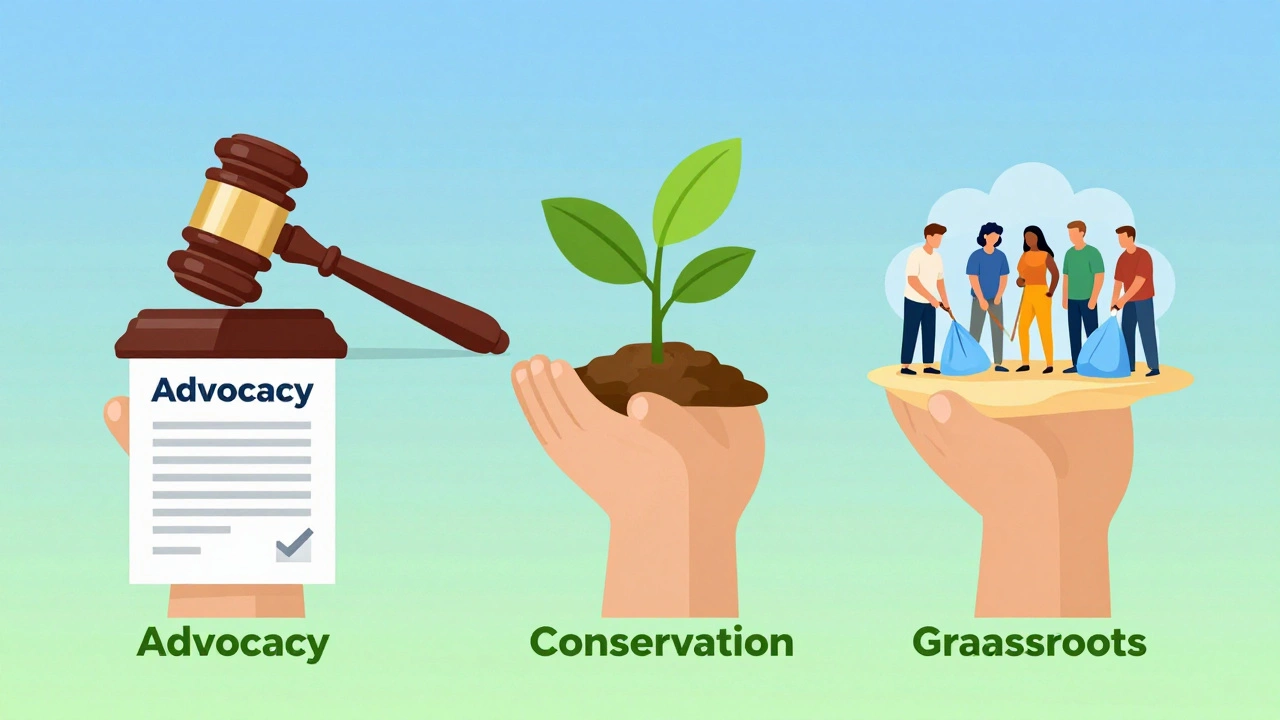
Before you pick a side, it helps to know what kind of player you are dealing with. The environmental sector is vast, but most groups fall into three main buckets: advocacy, conservation, and grassroots action. Each has a different strategy, funding model, and way of measuring success.
Advocacy Groups are organizations that focus on changing laws, policies, and corporate behavior through lobbying, litigation, and public pressure. They don't usually hold land or plant trees directly. Instead, they work in boardrooms and courtrooms. Think of them as the lawyers and lobbyists of the green movement. Their goal is systemic change. If you want to stop a pipeline from being built, these are the people drafting the injunctions.
Conservation Groups are non-profits dedicated to protecting specific ecosystems, wildlife species, or natural resources through direct management and land acquisition. These groups often buy land to keep it off the market, manage national parks, or run breeding programs for endangered animals. They get their hands dirty. If you care about saving the koala or protecting the Great Barrier Reef, these organizations are on the front lines physically managing those spaces.
Grassroots Movements are community-led initiatives driven by local volunteers rather than large institutional funding. These groups organize clean-ups, protests, and educational workshops. They are hyper-local and highly visible. If you want to see immediate results in your own neighborhood, this is where you find people ready to roll up their sleeves.
Major Global Players: The Giants of Climate Action
When people ask about environmental groups, they often think of the big names first. These organizations have massive budgets, global reach, and significant political influence. Supporting them means contributing to well-oiled machines that can tackle problems at a planetary scale.
| Organization | Primary Focus | Key Strategy | Best For |
|---|---|---|---|
| Greenpeace | Anti-nuclear, anti-whaling, climate justice | Non-violent direct action and media stunts | People who believe in bold, visible protest |
| World Wildlife Fund (WWF) | Biodiversity and wildlife conservation | Partnerships with governments and corporations | Those interested in animal protection and science |
| The Nature Conservancy | Land and water conservation | Purchasing land and scientific research | Supporters of practical, on-the-ground preservation |
| Sierra Club | Climate policy and renewable energy | Lobbying and member mobilization | Voters wanting to influence US environmental policy |
Greenpeace is an independent global campaigning organization that uses non-violent creative confrontation to expose global environmental problems. Founded in 1971, they are famous for sailing ships into whaling zones or climbing oil rigs. Their approach is controversial because they often target corporations aggressively. However, their ability to shift public opinion is unmatched. If you donate here, you are funding high-visibility campaigns that dominate news cycles.
World Wildlife Fund (WWF) is the world's leading international organization for the protection of nature and wildlife. Recognizable by its panda logo, WWF works in over 100 countries. They take a more collaborative approach, working with businesses to reduce supply chain impacts and with governments to establish protected areas. They rely heavily on scientific data. This makes them a solid choice if you prefer evidence-based solutions over radical activism.
Australian Environmental Groups: Local Impact
Living in Australia, we face unique challenges. Our biodiversity is incredibly distinct but also fragile. Droughts, bushfires, and coral bleaching are not distant threats; they are current events. Supporting local Australian groups ensures your contribution addresses issues specific to our continent.
Australian Conservation Foundation (ACF) is Australia's oldest and largest national environmental organization, focusing on policy change and community education. Based in Melbourne, the ACF is a powerhouse in domestic politics. They lobby the federal government on everything from carbon pricing to native title rights. They are particularly strong on issues affecting Indigenous communities, recognizing that traditional owners are often the best custodians of the land. If you want to influence Australian law, ACF is the key player.
Friends of the Earth Australia is a network of local groups advocating for social justice and ecological sustainability through grassroots activism. Unlike the more centralized ACF, Friends of the Earth operates as a federation of state-based groups. This structure allows them to be nimble and responsive to local crises. They are known for their strong stance against mining projects and fossil fuel expansion. They empower local volunteers to take ownership of campaigns in their own cities.
Bush Heritage Australia is a charity that buys and protects private land to conserve Australia's threatened ecosystems and species. While many groups lobby, Bush Heritage acts. They purchase property from developers and turn it into permanent reserves. As of 2025, they protect millions of hectares across the country. Donating to Bush Heritage literally buys land. It is one of the most concrete ways to ensure a patch of forest never gets cleared.
How to Choose the Right Group for You
Not every group is right for every person. Your values, skills, and resources should guide your decision. Here is a simple framework to help you decide where to put your energy.
- If you have money but little time: Consider donating to established conservation groups like Bush Heritage Australia or The Nature Conservancy. Your funds go directly toward land acquisition or long-term research. Look for groups with high ratings on charity evaluators to ensure low administrative overhead.
- If you have time but little money: Join a grassroots chapter like Friends of the Earth Australia. They need bodies for protests, phone banking, and community clean-ups. Your physical presence and labor are valuable assets.
- If you have professional skills: Offer pro bono services. Legal firms can support Earthjustice (a major US litigation group) or local equivalents. Marketers can help small NGOs with branding. Accountants can assist with compliance. Specialized skills are often scarcer than general donations.
- If you want political influence: Engage with advocacy groups like Australian Conservation Foundation. Attend their town halls, sign their petitions, and vote according to their policy recommendations. Political change requires numbers and noise.
Red Flags: How to Spot Ineffective Charities
Not all environmental groups are created equal. Some are better at fundraising than fixing problems. Before you commit, do a quick background check. Transparency is non-negotiable.
Look for clear financial reports. A reputable NGO will publish an annual report detailing exactly how much money goes to programs versus administration. If less than 70% of donations go directly to mission-related activities, be cautious. High administrative costs aren't always bad, but they should be justified by scale and impact.
Check their track record. Have they achieved measurable goals? Did they actually save the wetland they promised to protect? Vague promises like "making the world greener" are marketing fluff. Specific outcomes like "restored 500 hectares of mangrove forest" are evidence of competence.
Beware of conflict-of-interest groups. Some organizations claim to be environmental but accept heavy funding from industries they regulate. This creates a bias. Independent groups like Greenpeace refuse corporate donations entirely to maintain integrity. Others, like WWF, partner with companies but disclose these relationships. Read the fine print.
Getting Started: Practical First Steps
You don't need to join a board or donate a million dollars to make a difference. Start small and build momentum. Here is a realistic plan for someone new to environmental activism.
- Identify your passion. Do you love oceans? Forests? Urban sustainability? Pick one area. Focusing your energy makes you more effective than spreading yourself thin.
- Research local chapters. Search for "environmental groups near me" or look up the local branch of national organizations. In Melbourne, you might find groups focused specifically on Port Phillip Bay conservation.
- Attend one event. Go to a cleanup, a lecture, or a meeting. See if the culture fits. Are people welcoming? Is the leadership transparent?
- Commit to a recurring action. Sign up for monthly newsletters, set up a small recurring donation, or volunteer two hours a month. Consistency beats intensity.
- Educate others. Share what you learn. Talk to friends and family. Social pressure is a powerful tool for change.
The environmental crisis is complex, but the solution starts with individual action multiplied by collective effort. By choosing the right environmental groups, you align yourself with experts who are already doing the hard work. Whether you are fighting in parliament, planting trees in the bush, or protesting on the street, your contribution matters. The question isn't whether you can make a difference; it's which path you choose to walk.
What is the most effective environmental group to donate to?
Effectiveness depends on your goals. For direct land protection, Bush Heritage Australia or The Nature Conservancy are highly rated because donations directly purchase land. For policy change, Australian Conservation Foundation is a top choice in Australia. Always check charity evaluators like GiveWell or Charity Navigator for detailed financial breakdowns.
How do I verify if an environmental charity is legitimate?
Check if the organization is registered as a non-profit in your country. In Australia, look for endorsement by the Australian Charities and Not-for-profits Commission (ACNC). Review their annual financial reports to see the ratio of program expenses to administrative costs. Legitimate charities are transparent about their funding sources and outcomes.
What is the difference between Greenpeace and WWF?
Greenpeace focuses on non-violent direct action and protest to raise awareness and pressure governments/corporations. They do not accept government or corporate funding. WWF focuses on scientific conservation and partnerships with governments and businesses to protect wildlife and habitats. WWF accepts corporate sponsorships, while Greenpeace does not.
Are there environmental groups specifically for young people?
Yes. Fridays for Future is a global youth-led movement inspired by Greta Thunberg, focusing on school strikes for climate. Surfrider Foundation also has strong youth chapters focused on ocean conservation. Many larger NGOs like WWF have "Junior" programs designed to engage students in conservation activities.
Can I volunteer remotely for an environmental group?
Absolutely. Many organizations need remote help with tasks like social media management, translation, data analysis, and online fundraising. Platforms like UNV Online Volunteering connect skilled volunteers with NGOs worldwide. Even if you cannot travel, your digital skills can support field operations significantly.