Charitable Trust vs Foundation: Which Structure Is Better for Your Cause?
 Jul, 21 2026
Philanthropy Structure Advisor
Your Situation
Select your options and click "Analyze Best Fit" to see which structure aligns with your goals.
You want to give back. You have the resources, the passion, and a clear vision for the change you want to see in your community or beyond. But before you write that first check, you hit a wall of legal jargon. Should you set up a charitable trust or a foundation? It sounds like splitting hairs, but the difference dictates how much control you keep, how much tax you save, and whether your legacy lasts ten years or a century.
This isn't just about paperwork. It's about choosing the engine that will power your generosity. Get it wrong, and you might find yourself bogged down in administrative fees, restricted by rigid rules, or facing unexpected tax bills. Get it right, and your money works harder than ever for the causes you care about.
What Exactly Are We Comparing?
To make this decision, we need to strip away the fluff and look at what these entities actually are. In the world of philanthropy, "foundation" and "trust" are often used interchangeably by the public, but legally, they are distinct structures with different rules.
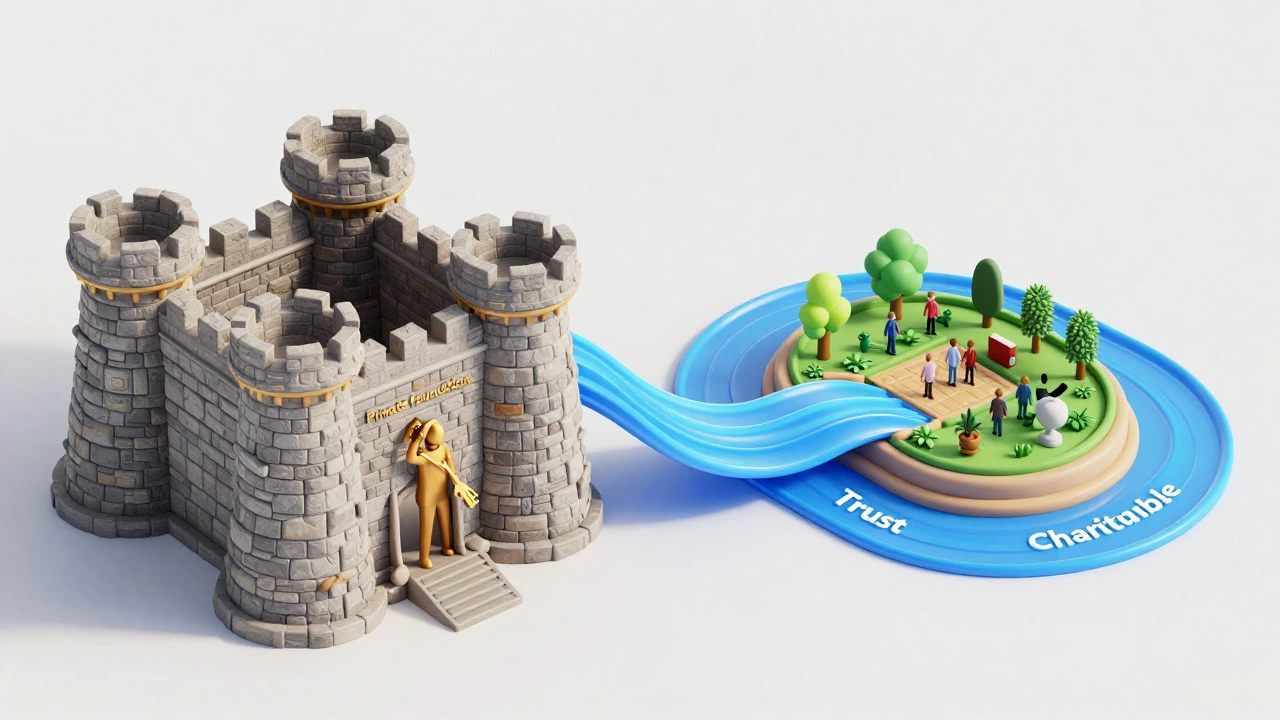
The key distinction lies in control versus flexibility. A foundation offers long-term control over a fund. A trust often offers immediate tax benefits and structured payout schedules.
The Control Factor: Who Holds the Reins?
If you love micromanaging details, a foundation might be your sweet spot. As a private foundation, you appoint the board members. You can include yourself, your children, or trusted advisors. You review grant applications. You choose which local food bank gets funded this quarter and which research lab gets support next year. This level of engagement keeps you connected to your mission.
However, this control comes with a heavy responsibility. The IRS (in the US) or equivalent tax authorities in other jurisdictions require foundations to distribute a minimum percentage of their assets annually-usually 5%. If you don't spend it, you face penalties. You also need to file annual returns (Form 990-PF in the US), which are complex and costly.
With a charitable trust, especially a pooled income fund or a donor-advised fund (which functions similarly to a trust in many ways), you relinquish some direct control. You recommend grants, but the sponsoring organization makes the final call. This reduces your administrative burden significantly. You get the tax deduction now, and you can suggest where the money goes later, without hiring a staff member to process checks.
Tax Implications: The Bottom Line
Let’s talk money, because that’s often why people start these structures in the first place. Both options offer significant tax advantages, but they work differently.
Foundations: When you contribute cash to a private foundation, you can generally deduct up to 30% of your adjusted gross income (AGI) in the US. For appreciated assets like stocks, the limit is often 20%. You avoid capital gains tax on those assets if you donate them directly. However, foundations are subject to excise taxes on their investment income if they don't meet the payout requirements.
Trusts: A Charitable Remainder Trust (CRT) allows you to sell appreciated assets without paying capital gains tax immediately. The trust sells the asset, invests the proceeds, and pays you an income stream for life or a set term. At the end, the remainder goes to charity. You get an upfront tax deduction based on the present value of the charitable remainder. This is powerful for high-net-worth individuals looking to smooth out income and reduce estate taxes.
| Feature | Private Foundation | Charitable Remainder Trust (CRT) |
|---|---|---|
| Initial Donation Deduction Limit | Up to 30% of AGI (cash) | Up to 60% of AGI (depending on age/term) |
| Capital Gains Tax | Avoided if donating appreciated stock | Avoided; trust can sell assets tax-free |
| Ongoing Tax Filing | Annual Form 990-PF required | Annual Form 1041 required (complex) |
| Payout Requirement | Minimum 5% of assets annually | Fixed income to donor, remainder to charity |
Cost and Complexity: The Hidden Burden
Here is the part no one tells you until you’re staring at the invoice. Setting up a standalone private foundation is expensive. You need lawyers to draft the charter, accountants to handle the initial tax-exempt status application, and potentially a small staff to manage grants. Annual operating costs can easily range from $10,000 to $20,000 or more, depending on the size of the fund.
If your endowment is under $1 million, the administrative costs might eat up a significant portion of your potential grants. In this scenario, a Donor-Advised Fund (DAF) or a pooled trust is often smarter. These vehicles charge lower fees because they spread overhead across thousands of donors. You get the same tax benefits and similar control over grant recommendations, but without the headache of running a mini-nonprofit.
Charitable trusts also have setup costs, particularly legal fees for drafting the irrevocable trust document. However, once established, they can be self-directed, meaning you manage the investments yourself, potentially saving on trustee fees. But beware: managing investments requires expertise. Poor performance means less money for both you and the charity.
Longevity and Legacy
Do you want your name on a building for fifty years? Or do you want to solve a specific problem today?
Private foundations are designed for perpetuity. They can last forever, as long as they comply with laws and maintain their endowment. This makes them ideal for families who want to create a lasting legacy, engaging future generations in philanthropy. Many historic foundations were started over a century ago and still operate today.
Trusts are often finite. A CRT ends when the income term expires or the last beneficiary dies. A CLT ends when the lead term completes. This makes trusts excellent for specific goals, like funding a scholarship for ten years or supporting a capital campaign. They are less suited for open-ended, evolving missions.

Which One Fits Your Situation?
There is no single "better" option. The right choice depends on your personal financial situation, your desire for involvement, and your philanthropic goals.
- Choose a Private Foundation if: You have a large endowment ($2M+), want full control over grantmaking, wish to involve family members in decision-making, and are prepared for the administrative workload and costs.
- Choose a Charitable Trust (CRT) if: You hold highly appreciated assets, want to eliminate capital gains tax, need an income stream in retirement, and prefer a structured, time-limited giving plan.
- Consider a Donor-Advised Fund instead if: You want simplicity, low costs, and immediate tax deductions without the burden of running an organization. It’s the "middle ground" that satisfies most casual donors.
Common Pitfalls to Avoid
Even seasoned philanthropists stumble here. First, don’t underestimate the compliance burden. Foundations must avoid "self-dealing," where insiders benefit personally from foundation transactions. Renting office space from your foundation? Bad idea. Paying yourself above-market salary as an employee? Also bad. The penalties are steep.
Second, don’t ignore the payout rule. If your foundation grows faster than you spend, you’ll owe taxes on the excess. Plan your investment strategy to align with your spending goals.
Third, ensure your trust documents are airtight. Once a charitable trust is irrevocable, you can’t change your mind. If you pick the wrong charity or the terms are too restrictive, you’re stuck. Work with an experienced estate attorney.
Can I convert a foundation into a trust?
Yes, but it’s complex. You can terminate a private foundation and distribute its assets to a charitable trust or another exempt organization. This requires IRS approval and careful legal structuring to avoid tax penalties. It’s often done when a family wants to simplify administration.
Is a Donor-Advised Fund (DAF) the same as a trust?
Not exactly. A DAF is an account within a public charity, not a separate legal entity like a trust. However, it offers similar benefits: tax deductions, growth potential, and grant recommendation rights. It’s simpler and cheaper than a private foundation or complex trust.
What is the minimum amount to start a private foundation?
There is no legal minimum, but practically, you should have at least $1 million to $2 million. Below that, the administrative costs (legal, accounting, filing) can consume a disproportionate share of your funds, making a DAF or pooled trust more efficient.
Do I have to live in the same country as my foundation?
No. Many Americans establish foundations in other countries, and vice versa. However, cross-border philanthropy involves complex tax treaties and reporting requirements. Consult a global tax advisor to navigate withholding taxes and double-taxation issues.
Can I change the charity I support in a trust?
It depends on the trust type. In a Donor-Advised Fund, you can recommend grants to any qualified charity at any time. In an irrevocable Charitable Remainder Trust, the beneficiary charity is usually fixed at creation. Some trusts allow for cy pres doctrines, where a court can redirect funds if the original charity dissolves, but changing your mind arbitrarily is difficult.