Most Popular School Activities: A Guide for Parents and Students
 Nov, 17 2026
School Activity Finder
Not sure which club is right for your child? Answer three quick questions to get personalized recommendations based on national trends.
Your Preferences
You’ve probably seen the flyers taped to the fridge door. "Join Chess Club!" "Soccer Tryouts Friday!" "Drama Workshop Starting Soon." It’s overwhelming, right? You want your kid to have fun, make friends, maybe even boost their college resume, but you don’t know where to start. The truth is, there isn’t one single most popular school activity that works for everyone. Popularity depends on age, location, and what your child actually enjoys. But if we look at national trends and enrollment data from major education bodies like the National Association of Elementary School Principals, certain categories consistently dominate.
Why does this matter? Because picking the wrong club can lead to burnout or boredom. Picking the right one can spark a lifelong passion. We’re going to break down the heavy hitters in the world of extracurriculars, explain why they’re popular, and help you figure out which ones might fit your family’s schedule and budget. No fluff, just real talk about what’s happening in schools today.
Sports Dominate the After-School Landscape
Let’s not beat around the bush: sports are still king. Whether it’s team-based or individual, physical activity remains the top choice for students across most grade levels. According to recent surveys by the National Federation of State High School Associations (NFHS), participation in high school sports has hit record highs, with over 8 million students playing interscholastic sports in the US alone. In Australia, similar trends show strong uptake in community sports linked to schools.
But it’s not just about football or basketball anymore. The landscape has shifted. While traditional team sports hold their ground, individual and non-traditional sports are seeing massive growth. Think track and field, swimming, tennis, and increasingly, esports (yes, competitive gaming counts as a sport in many districts now).
| Sport Type | Primary Age Group | Key Benefit | Typical Commitment |
|---|---|---|---|
| Team Sports | All Ages | Collaboration & Leadership | High (3-5 days/week) |
| Individual Sports | Middle & High School | Self-Discipline & Focus | Medium (2-3 days/week) |
| Esports | Middle & High School | Strategic Thinking & Tech Skills | Low-Medium (1-2 evenings) |
Why do parents push for sports? It’s simple. Coaches teach resilience. Losing a game hurts, but getting back up teaches more than a textbook ever could. Plus, the social aspect is huge. If your kid feels left out during lunch, finding a team gives them an instant friend group with shared interests.
The Arts Are Making a Major Comeback
If sports are the muscle, arts are the soul. And lately, the soul is getting a lot of attention. Drama, music, and visual arts clubs are experiencing a renaissance. This isn’t just because kids love acting; it’s because schools are realizing the cognitive benefits. Studies published in journals like *Child Development* suggest that early exposure to music improves language skills and memory.
Drama clubs, in particular, are booming. Why? Because they offer a safe space for shy kids to step into the spotlight without the pressure of being "the best." Theater builds empathy. When you play a character different from yourself, you learn to understand perspectives outside your own bubble. Music bands and choirs remain staples too. They require discipline-showing up to practice when you’d rather be sleeping-but the payoff is performing together. That sense of unity is hard to replicate elsewhere.
Visual arts, like painting or digital design clubs, are growing fast too. With the rise of content creation, kids aren’t just drawing pictures; they’re learning graphic design, video editing, and animation. These are practical skills that translate directly into future careers. If your child loves doodling during homework, a digital art club might turn that distraction into a portfolio.
STEM Clubs: Beyond Just Math Homework
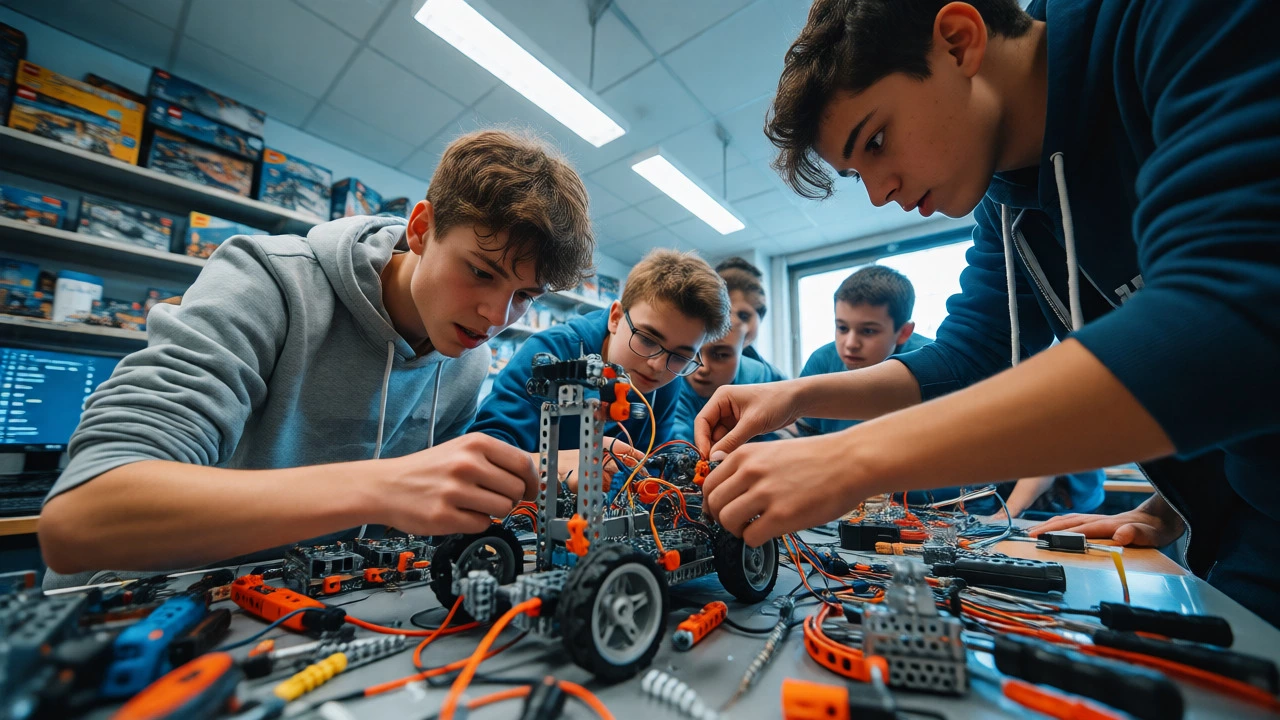
STEM stands for Science, Technology, Engineering, and Mathematics. For years, these clubs were seen as remedial-places for kids who needed extra help with math. Not anymore. Today, STEM clubs are hubs for innovation and problem-solving. Robotics teams, coding boot camps, and science fairs are some of the most competitive and sought-after spots in any school.
Take robotics, for example. Teams like FIRST LEGO League or VEX Robotics have thousands of participants globally. Kids work in teams to build robots that solve specific challenges. It’s messy, loud, and incredibly rewarding. You see engineers-in-training debating gear ratios and programming logic while eating pizza. It’s collaborative engineering in action.
Coding clubs are also surging. Platforms like Scratch for younger kids and Python or JavaScript for older students make programming accessible. Unlike math class, where there’s often one right answer, coding allows for creativity. There are ten ways to write a loop, and all of them might work. This flexibility appeals to creative thinkers who hate rigid structures. If your child spends hours on Minecraft Redstone or building mods, a coding club is the natural next step.
Service Learning and Community Engagement
This category has exploded in popularity, especially among high schoolers looking to stand out in college applications. But beyond resumes, service clubs fulfill a deep human need to feel useful. Organizations like Key Club, Interact Club, or local environmental groups allow students to volunteer regularly.
What makes these clubs different? They connect students to the real world. Cleaning up a local beach, serving meals at a food bank, or tutoring younger students provides context to their education. It answers the eternal question, "Why do I need to learn this?" Suddenly, math helps you calculate how much rice is needed for 100 people. Writing skills help you draft grant proposals for a charity event.
Parents often underestimate the confidence boost here. When a teenager organizes a fundraiser and hits their goal, they realize they have agency. They can impact their community. That feeling sticks with you long after graduation. If your child seems disconnected or cynical, a service club might be the antidote.

Academic Competitions and Debate
Not every kid wants to run laps or paint canvases. Some thrive on intellectual combat. Debate teams, Model United Nations (MUN), and quiz bowls are fiercely popular among academically inclined students. These activities sharpen critical thinking and public speaking under pressure.
Debate, specifically, teaches you to argue both sides of an issue. You might believe strongly in something, but in debate, you have to defend the opposite view convincingly. This mental flexibility is invaluable. MUN takes it further by simulating global diplomacy. Students represent countries, negotiate treaties, and resolve conflicts. It’s essentially politics played with rules.
These clubs are less about physical stamina and more about research and rhetoric. They prepare students for university seminars and professional meetings. If your child loves arguing (and winning), channel that energy into a structured format like debate. It turns a household nuisance into a superpower.
How to Choose the Right Activity
So, how do you pick? Don’t just sign them up for what’s popular. Consider these factors:
- Interest vs. Aptitude: Does your child enjoy the activity, or are they good at it? Ideally, you want overlap, but enjoyment drives consistency.
- Time Commitment: Be realistic. Can you drive them three times a week? Is there homework time left?
- Social Circle: Sometimes joining a club is easier if a friend joins too. Check if peers are signing up.
- Cost: Sports gear and travel fees add up quickly. Arts and academic clubs are often cheaper, though materials costs vary.
A pro tip: Start small. One activity per semester is plenty for younger kids. Overloading schedules leads to resentment. Let them try something new each term. If they hate drama club, drop it. No guilt. The goal is exploration, not commitment to a life path at age ten.
Are after-school activities necessary for college admissions?
Yes, but quality matters more than quantity. Admissions officers prefer students who stick with one or two activities deeply over those who join five superficially. Depth shows commitment and leadership potential.
What if my child doesn't want to join any clubs?
It’s okay. Some kids recharge through solitude. However, gently encourage low-pressure options like library reading groups or online hobby communities. Ensure they aren’t isolating due to anxiety or bullying.
How much do school activities typically cost?
Costs vary widely. Academic clubs are often free or nominal ($10-$50/year). Sports can range from $50 for intramural leagues to $1,000+ for travel teams including gear and tournament fees. Many schools offer fee waivers based on income.
Can online activities count as extracurriculars?
Increasingly, yes. Competitive coding platforms, virtual chess leagues, and moderated online book clubs are recognized, especially if they involve measurable achievement or community interaction. Always check specific school or university guidelines.
When is the best time to start joining clubs?
Elementary school is great for trying various things. Middle school is often when serious commitments begin due to higher stakes. However, it’s never too late. High school transfers often find new niches easily.